SOLAR SYSTEM GUIDE
2026 ED138: The New Dwarf Planet Candidate Explained
Published · Last updated
The short answer
- 2026 ED138 is an observed trans-Neptunian object announced on October 27, 2026: a dwarf planet candidate, not a confirmed sixth dwarf planet.
- The discovery team reports a current solar distance of about 46 AU, an estimated size of 600–1,500 km and an orbit tilted nearly 25°. These are approximate, not precise measurements of a resolved globe.
- Do not treat it as tonight’s backyard visual target. The official discovery images are the practical way to explore it; local sky scores do not predict its detectability.
A newly identified world can be real without its classification being settled. This guide separates the measured moving object from the inferred size, explains what would change its status, and keeps the discovery distinct from an observing recommendation.
The orbit, not a close-up photograph
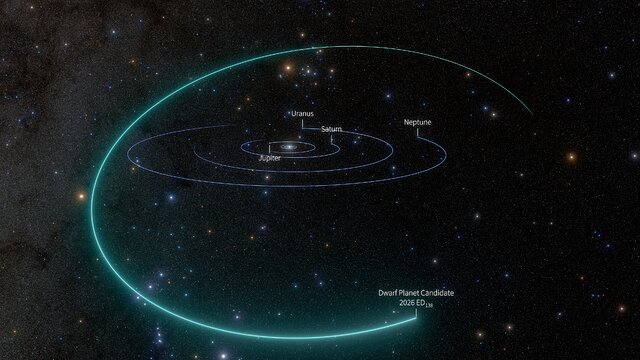
Official orbital model, with the candidate shown at its May 8, 2026 position. This is a visualization, not a surface photograph, a size comparison or tonight’s finder chart.
NSF–DOE Vera C. Rubin Observatory/NOIRLab/SLAC/AURA/R. Proctor. Image processing: M. Zamani (NSF NOIRLab). Orbit data: IAU Minor Planet Center (MPCorb), funded by NASA PDCO and the Tamkin Foundation. Star map: NASA/Goddard Space Flight Center Scientific Visualization Studio. Gaia DR2: ESA/Gaia/DPAC.
Official image and full caption ↗ · CC BY 4.0 ↗ · CC BY 4.0 · usage policy ↗
If the externally hosted image does not load, open the official image page.
What is 2026 ED138?
2026 ED138 is a small Solar System world orbiting beyond Neptune. Trans-Neptunian object, usually shortened to TNO, describes that orbital setting; it does not automatically mean dwarf planet. The discovery release calls it a hot-classical TNO. Here, hot refers to an orbit that is dynamically excited or tilted, not a warm surface.
Its alphanumeric provisional designation is a catalogue identifier, not a formal personal name, a temperature or a telescope model. The 2026 label belongs to the observation/designation year; it should not be mistaken for proof that the object first existed, or was first photographed, in October. Archive detections are older than the discovery announcement.
These terms answer different questions. TNO describes an orbital population, asteroid is a broad small-body term, and dwarf planet is a physical and dynamical classification. None makes ED138 the ninth planet. A clear explanation keeps an observed object, its provisional label and its proposed classification separate.
Sources: Rubin Observatory ↗ · NASA: dwarf planets ↗
Why is it a candidate rather than a confirmed dwarf planet?
IAU Resolution B5 sets four conditions: the body orbits the Sun; its self-gravity gives it an approximately equilibrium, nearly round shape; it has not cleared its orbital neighbourhood; and it is not a satellite. Round does not require a perfect billiard ball: rotation can distort a large body, as Haumea illustrates.
For ED138, the physical inference is still preliminary. Reflected brightness combines size and surface reflectivity, or albedo. A smaller reflective object and a larger darker object can produce similar brightness. The 600–1,500 km interval expresses that uncertainty; averaging its endpoints would not create a newly measured diameter.
Rubin says infrared observations are needed to constrain the size and nature of the object. Such measurements can help separate reflected sunlight from the thermal behaviour of a surface, but they do not automatically equal an IAU recognition decision. The official sources checked here give no confirmation deadline or guaranteed JWST observation. If formally recognized, it would join the five currently recognized dwarf planets; until then, sixth is conditional.
Sources: IAU Resolution B5 ↗ · Rubin Observatory ↗ · NASA: dwarf planets ↗
How did Rubin find a world that older surveys missed?
The public announcement was made on October 27, 2026. Matthew Holman of the Center for Astrophysics | Harvard & Smithsonian identified the moving object while analysing earlier Rubin data on October 13, using search code developed with Kevin Napier. Mario Jurić of the University of Washington helped recover additional observations.
Rubin’s Simonyi Survey Telescope, at Cerro Pachón in Chile, recorded it 30 times on 20 nights between March 4 and July 11, 2026. Earlier DECam images extend the observational record back to 2016. Finding an object in old images after discovering it is called precovery: the images were already there, but their moving point had not yet been linked to this object.
The object lies against a crowded Milky Way star field. A moving dot is harder to identify when many background sources overlap its path; repeated imaging and linking observations matter as much as a single impressive photograph. Its nearly 25° orbital tilt is consistent with a history of gravitational disturbance, including possible interactions with Neptune. It does not, by itself, reconstruct a unique past encounter.
Sources: Rubin Observatory ↗ · University of Washington ↗
How big is it beside the recognized dwarf planets?
The comparison below is deliberately approximate. ED138’s row is an inferred size range, not a resolved diameter. The other rows summarize rounded NASA reference values; Haumea’s value is an equatorial dimension of an elongated object, not the diameter of a spherical body.
Do not rank ED138 confidently within this table. Its broad interval overlaps the scale of several known worlds. Also notice the different distance basis: the known bodies use average orbital distances, while 46 AU describes ED138 near the discovery announcement. A current position is not an orbital average or a distance from Earth.
On a narrow screen, scroll within this table to read all four columns.
| World | Solar distance (AU) | Approximate size (km) | Status |
|---|---|---|---|
| Pluto | ≈39orbital average | ≈2,377 | Recognized dwarf planet |
| Ceres | ≈2.8orbital average | ≈950 | Recognized dwarf planet |
| Eris | ≈68orbital average | ≈2,326 | Recognized dwarf planet |
| Haumea | ≈43orbital average | ≈1,740equatorial; elongated | Recognized dwarf planet |
| Makemake | ≈45.8orbital average | ≈1,430 | Recognized dwarf planet |
| 2026 ED138 | ≈46current, not orbital average | 600–1,500 | Candidate — unconfirmed |
Sources: NASA: sizes and locations ↗ · NASA: Ceres facts ↗ · NASA: Haumea ↗ · NASA: Makemake ↗ · Rubin Observatory ↗
Why does this discovery matter?
This is Rubin’s first announced dwarf planet candidate, not humanity’s first candidate beyond the recognized five. The useful scientific result is another well-tracked member of the outer Solar System. Comparing the sizes, surface properties and orbits of such bodies helps test ideas about early formation and the migration of the giant planets.
Rubin’s repeated southern-sky survey is intended to build a ten-year record of changes and motion. A crowded field that defeated an earlier search can become tractable when many nights are connected. That suggests a way to find more overlooked objects; it is not a promise of a particular number of new planets, a rewritten textbook or an imminent official classification.
Sources: Rubin Observatory ↗ · University of Washington ↗
Can you see 2026 ED138 tonight?
For an ordinary backyard visual session, do not plan around ED138. Being large in kilometres does not make a distant object bright in an eyepiece, and a distant moving point must also be distinguished from background stars. The release does not supply a beginner finder chart, an aperture recommendation or a verified backyard visibility limit.
That is different from claiming that no advanced amateur imaging setup could ever record it. Detection in stacked camera images, visual identification at the eyepiece and resolving a disk are very different achievements. Without verified brightness and equipment-specific limits, this guide does not invent a magnitude, telescope size, compass direction or best clock time.
For an achievable session, consider the Moon, bright planets or a dated meteor-shower window, then check clouds, darkness, moonlight and legal site access. Starry Forecast’s city score describes sky conditions, not an object-specific detection probability. The linked meteor calendar selects upcoming reviewed windows automatically; use its current panel rather than treating this article’s publication date as a live event recommendation.
Sources: Rubin Observatory ↗
Is 2026 ED138 Planet Nine?
No. ED138 is a specific observed TNO and dwarf planet candidate. Planet Nine refers to a separate hypothesis about an undiscovered major planet; identifying this object does not establish that hypothesis. Candidate dwarf planet, confirmed major planet and hypothetical planet are not interchangeable labels.
Sources: Rubin Observatory ↗ · NASA: dwarf planets ↗
Frequently asked questions
Is 2026 ED138 a planet?
It is not a confirmed major planet. The discovery identifies an observed TNO whose size makes it a dwarf planet candidate; classification remains provisional.
Is it the sixth dwarf planet?
Not yet. If recognized by the IAU, it would join the five recognized dwarf planets; the discovery announcement alone does not add it to that list.
How far is it from the Sun?
The release reports about 46 AU at the time of the announcement. That is an approximate current Sun–object distance, not a fixed Earth distance or an adopted orbital average.
How big is it?
The initial estimate is 600–1,500 km, inferred from distance, brightness and assumed reflectivity. Infrared follow-up is needed; 1,000 km should not be presented as a measured result.
Can I see it with a telescope?
It is not a practical ordinary backyard visual target. Specialized imaging is a separate question; this guide does not claim a universal impossibility for every amateur camera system.
When will it be confirmed?
No official confirmation date was found in the sources checked on October 29. We will revise the status when authoritative classification or physical-size results are actually published, not on a guessed schedule.
How does a dwarf planet differ from a planet?
Both orbit the Sun and have enough gravity for an approximately equilibrium shape. A dwarf planet has not cleared its orbital neighbourhood and is not a satellite; the category is not simply a planet below an arbitrary diameter.
Who discovered it?
Matthew Holman identified it in Rubin data using code developed with Kevin Napier. Mario Jurić and archival-image searches helped establish a longer observational record; the work involved a team, not a lone telescope snapshot.
Choose something to observe tonight
Sources and accuracy note
Facts checked October 29, 2026. The cited discovery reports describe a candidate, not formal recognition. Distances and sizes are approximate; current and average distances are labelled separately. This guide is explanatory, not an ephemeris or a personal visibility forecast.
- Rubin Observatory ↗ · Sources checked:
- University of Washington ↗ · Sources checked:
- IAU Resolution B5 ↗ · Sources checked:
- NASA: dwarf planets ↗ · Sources checked:
- NASA: sizes and locations ↗ · Sources checked:
- NASA: Ceres facts ↗ · Sources checked:
- NASA: Haumea ↗ · Sources checked:
- NASA: Makemake ↗ · Sources checked:
What would trigger an update?
An IAU status decision, a published infrared size/albedo result or a material correction to the orbit or discovery record will trigger a source review. JWST is not a promised appointment here. An unchanged source check does not reset this article’s last-updated date.